Does a birth date predict compatibility? What the research actually found
NUMERA uses birth dates as a symbolic framework for reflection. We have no scientific validation that these numbers predict relationship outcomes. Here is what relevant research tested, where its conclusions stop, and what our reading actually offers.
Prepared by NUMERA
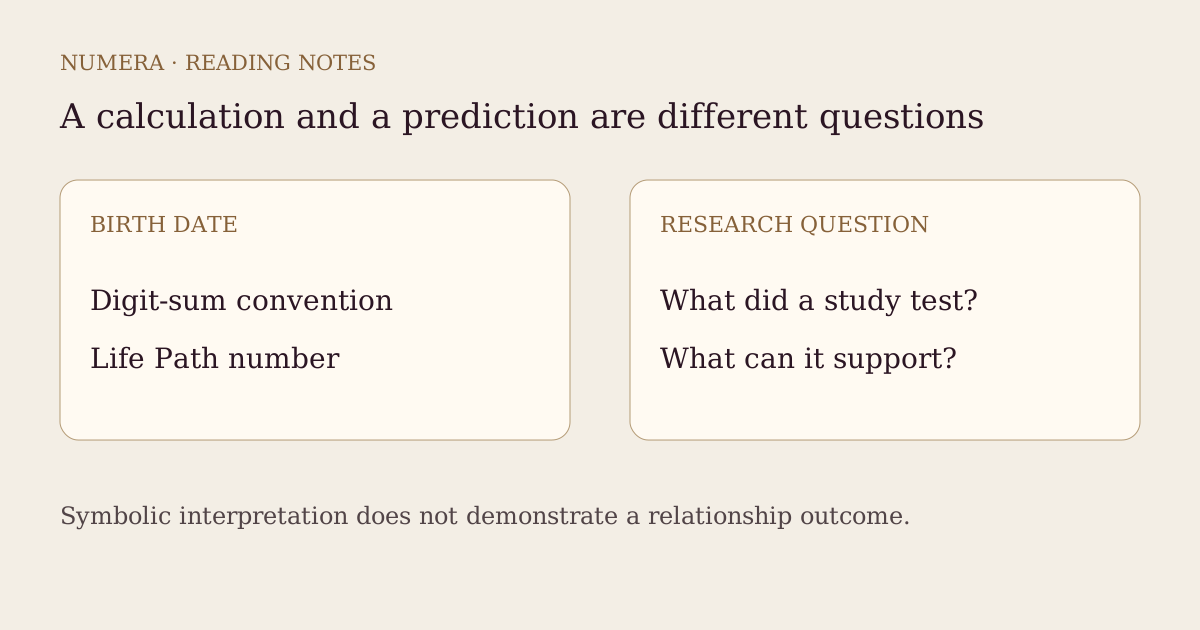
What ten million marriages tell us about sun signs
David Voas examined sun-sign pairings among more than ten million married couples in the 2001 census of England and Wales. After investigating recording and imputation artefacts, he found no evidence for the proposed sun-sign association.
This was a study of census marriage patterns, not a longitudinal test of divorce or a test of Life Path numerology. It does not establish that every variable involving a birth date is irrelevant to relationships.
Relationship quality is different from matching strangers
Joel and colleagues combined 43 longitudinal datasets involving 11,196 couples. Relationship-specific self-reports predicted up to 45% of baseline relationship-quality variance; individual differences also predicted a meaningful share, up to 21%.
Individual differences and partner reports added little beyond the person's own relationship-specific reports. Changes in quality were largely unpredictable. This does not mean personality is irrelevant or test whether a service can match strangers before they meet.
The practical limit for NUMERA is clear: this research does not validate our numerology, index or report. We use your answers to shape reflection, not to claim a tested prediction.
Any reading will feel accurate. That is a known effect, not evidence
In 1949, 39 students were each handed what they believed was a personal profile. Every profile was identical. They rated the accuracy at 4.26 out of 5. In a later experiment with 52 participants, a generic profile was rated as more accurate than a real horoscope — by believers and sceptics alike.
This matters for reading anything about yourself, including ours. The feeling of recognition you get from a personalised description is not evidence that the description was derived from your data. We would rather say that out loud than let the feeling do the selling.
What the public already thinks
People are ahead of the industry on this. In a Pew Research Center survey of 9,593 US adults, published in May 2025, 30% said they consult astrology, tarot or fortune tellers at least yearly — but 20% do it just for fun against 10% for insight, and only about 1% say they rely on it a lot when making major decisions.
The audience is treating this as a mirror, not a forecast. The products should say the same thing.
Then what is a compatibility reading good for?
Two things, neither of which requires the birth date to be predictive.
The first is language for reflection. A laboratory affect-labeling study found reduced amygdala responses to negative images when participants named emotions. It did not test couples using a reading. A shared label is something to try, not a proven effect of NUMERA.
The second is a concrete next step. A meta-analysis of 94 implementation-intention tests found a benefit for goal attainment. Separate trials tested therapist-led Marriage Checkups and a specific conflict-reappraisal writing exercise. Those interventions have their own evidence; adding a prompt to our reading does not reproduce or validate them.
Our offer is a symbolic vocabulary, reflection questions and specific actions you can consider. Whether a suggested action helps your situation remains something to assess in practice, not an outcome we can guarantee.
Questions people ask
Is birth-date or zodiac compatibility scientifically valid?
The sun-sign study discussed here did not support the pairing hypothesis it tested. It did not test Life Path numerology. NUMERA has no scientific validation for predicting relationship outcomes from its numbers.
Do personality tests predict couple compatibility better?
Personality-related differences can predict some variation in relationship quality. In the 2020 study discussed here, they added little beyond relationship-specific self-reports. That is different from testing a personality-matching service.
Why does a personalised reading still feel so accurate?
Because generic descriptions reliably feel personal. In the original 1949 experiment, 39 students given identical profiles rated their accuracy 4.26 out of 5, and a later study found a generic profile was rated more accurate than a real horoscope by believers and sceptics alike.
Does NUMERA claim to predict a relationship from two birth dates?
No. NUMERA produces interpretive, reflective content. Birth dates supply symbolic themes; the product's conventional indices are not validated measurements of compatibility or predictions. The visual pattern is an identity design.
Sources
- French, C. C. et al. (1991). Belief in astrology: a test of the Barnum effect. N = 52. Generic profiles were rated more accurate than genuine horoscopes by believers and sceptics alike.