Relationship statistics, checked
Relationship advice runs on numbers that nobody traced. These are the ones repeated most often, each checked against its primary source — including the ones that turned out to be true.
Prepared by NUMERA
Numbers that circulate but do not hold up
Each of these appears in books, coaching decks and the first page of search results. None of them survives being traced to a primary source.
"69% of relationship conflicts are perpetual and unsolvable."
Not supported. Traceable only to a commercial book. No sample size, no peer-reviewed publication, no method. The figure has no source to check.
"The marital 5:1 positivity ratio was retracted in 2013."
Misattributed. The 2013 correction withdrew the mathematical model and its 2.9 and 11.6 thresholds for human flourishing. It did not retract a marital 5:1 rule. Conflating these claims misstates the correction; it also does not establish 5:1 as a universal prescription.
"Divorce can be predicted with over 90% accuracy."
Misattributed. That accuracy comes from classifying couples after the outcome is already known. Tested predictively, positive predictive value fell to 29%, and to roughly 21% at real-world divorce rates. A separate attempt on 85 couples reported that the major findings failed to replicate.
"Couples who last turn toward each other 86% of the time, versus 33%."
Misattributed. These figures appear in an institute's own materials. The peer-reviewed study they are attributed to — 49 newlywed couples — does not report them.
"Money is the number one thing couples fight about."
Not supported. In a study logging 748 real conflicts from 100 couples, money ranked sixth at 18–19%, behind children (36–39%), chores (24–25%), communication (22%), leisure (20%) and work (19%). Money conflicts were about twice as likely to be postponed, which is probably the origin of the myth.
"A study of 2,000 couples found 65% higher satisfaction."
Not supported. No such study exists. The sentence appears only in marketing content that cites other marketing content.
"Opposites attract."
Untested. Joel et al. studied quality within existing couples, not whether opposite traits attract strangers. It cannot establish this matching rule or prove that traits never matter.
"Take a 20-minute break when your heart rate passes 100 bpm."
Not supported. Repeated as a rule with a specific threshold and a specific duration, neither of which has a traceable primary source. Taking a break to calm down does have support — the numbers attached to it do not.
"Venting anger first makes the conversation go better."
Not supported. Across 154 studies covering 10,189 people, activities that lower arousal reduced anger at g = −0.63, while activities that raise it — running, hitting something — produced g = −0.02, which is nothing.
"There is a best time of day for difficult conversations."
Untested. Comparable diary studies contradict each other, and the mechanisms usually invoked are broken: ego depletion replicated at d = 0.04 across 23 laboratories, and the "hungry judges" effect is confounded by non-random case ordering.
Claims about matching people in advance
This is the category NUMERA sells in, so it gets the same treatment as the rest.
"Star signs, or birth dates, indicate who you are compatible with."
Not supported. Voas found no evidence supporting sun-sign pairings in more than ten million census marriages after investigating recording artefacts. The study did not test Life Path numerology or follow couples through divorce.
"Personality matching predicts a good relationship."
Untested. The cited 43-dataset study did not test a matching service. Individual differences predicted relationship quality, but added little beyond relationship-specific self-reports. Neither this study nor its findings validate NUMERA.
"The reading felt accurate, so it must have been derived from my data."
Not supported. Identical profiles handed to 39 students were rated 4.26 out of 5 for accuracy. In a later study of 52 people, a generic profile was rated more accurate than a real horoscope, by believers and sceptics alike. Feeling recognised is not evidence of personalisation — including on our own pages.
What does hold up
Checking is not debunking. These have primary sources, stated samples and effects that survived testing.
A plan that specifies when, where and how beats a good intention.
Supported. Across 94 independent tests with more than 8,000 participants, implementation intentions produced d = .65 on goal achievement.
The therapist-led Marriage Checkup improved intimacy in a trial.
Supported. The 215-couple trial tested assessment and feedback sessions, repeated after a year. Intimacy favoured treatment over the two-year follow-up, with a median d = .37; this was not a trial of informal check-ins.
Twenty-one minutes of writing across a year can hold off decline.
Supported. In a study of 120 couples, seven minutes of structured perspective-taking writing three times a year removed the second-year decline in relationship quality seen in the control group.
Being well rested was associated with better conflict resolution.
Supported. In the study of 71 couples, resolution was most likely when both reported being well rested. The association does not establish that one tired partner prevents resolution.
Feeling appreciated moderated the association between unequal labour and satisfaction.
Supported. Across 2,193 people, including 476 couples, the negative association was absent among people who felt appreciated. This observational finding does not prove that appreciation substitutes for changing an unfair workload.
What your partner notices matters more than what your partner does.
Supported. In a 14-day diary study of 100 couples, perceived phone-snubbing predicted relationship quality while actual measured phone use predicted nothing — not the next day, not two months later.
Partners often cannot agree on what they are arguing about.
Supported. Asked separately for their three biggest problems, only 2% of 431 low-income couples agreed on all three, and about 19% agreed on none.
How to check one of these yourself
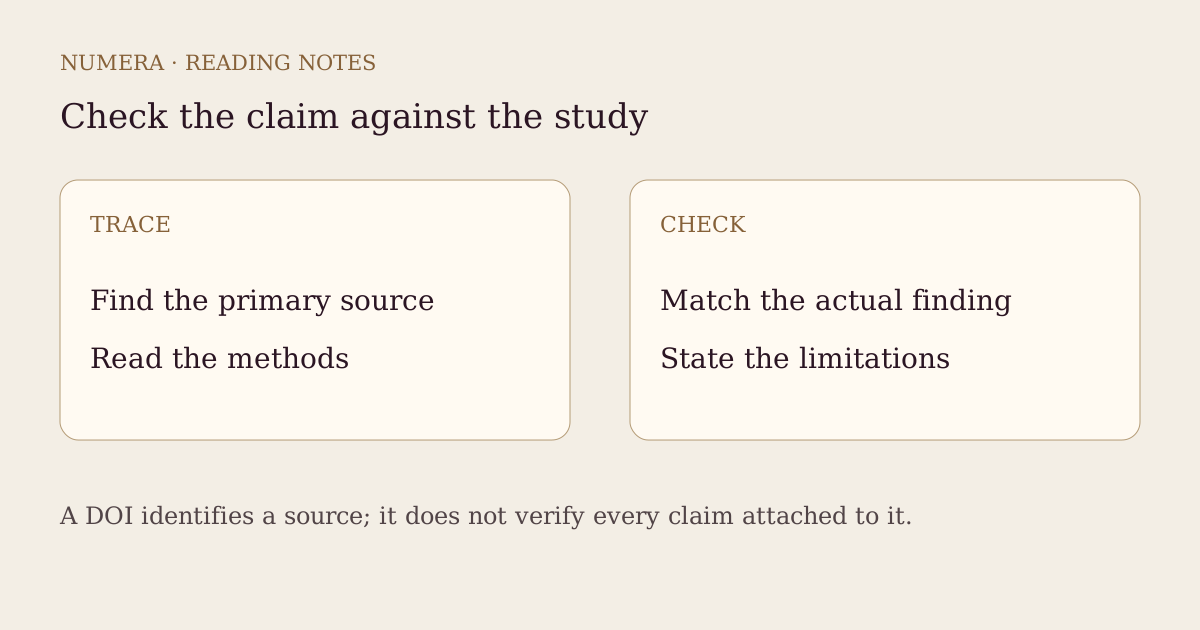
Check the population, the measure, the comparison and the study design. A DOI can help identify a paper, but resolving it only confirms its identity; you still need to read the methods and findings to see whether it supports the claim.
Keep an association distinct from an intervention effect, and a tested intervention distinct from a product inspired by it. The September 2026 review of this page corrected those distinctions, including an overstatement about personality and a conflation of two positivity ratios.
Questions people ask
Is the 69% figure about perpetual relationship problems real?
It has no traceable primary source. The figure appears in a commercial book without a sample size or a peer-reviewed publication behind it, so there is nothing to verify it against.
Was the 5:1 positivity ratio retracted?
No. The cited correction withdrew a different human-flourishing model and its proposed 2.9 and 11.6 thresholds. It does not establish or retract a universal marital 5:1 rule.
Can divorce really be predicted with 90% accuracy?
No. That figure comes from classifying couples after the outcome is known. Tested predictively, positive predictive value dropped to 29%, and to about 21% at real-world divorce rates.
Which relationship findings are actually well supported?
This page distinguishes trials of therapist-led Marriage Checkups and conflict-reappraisal writing from observational findings about sleep and appreciation. Each supports a narrower conclusion than a universal relationship rule, and none tested NUMERA.