Why the same argument keeps coming back
A recurring argument can involve different perceptions of the problem. These studies offer useful context, but they do not diagnose why your argument returns or prove that one exercise will resolve it.
Prepared by NUMERA
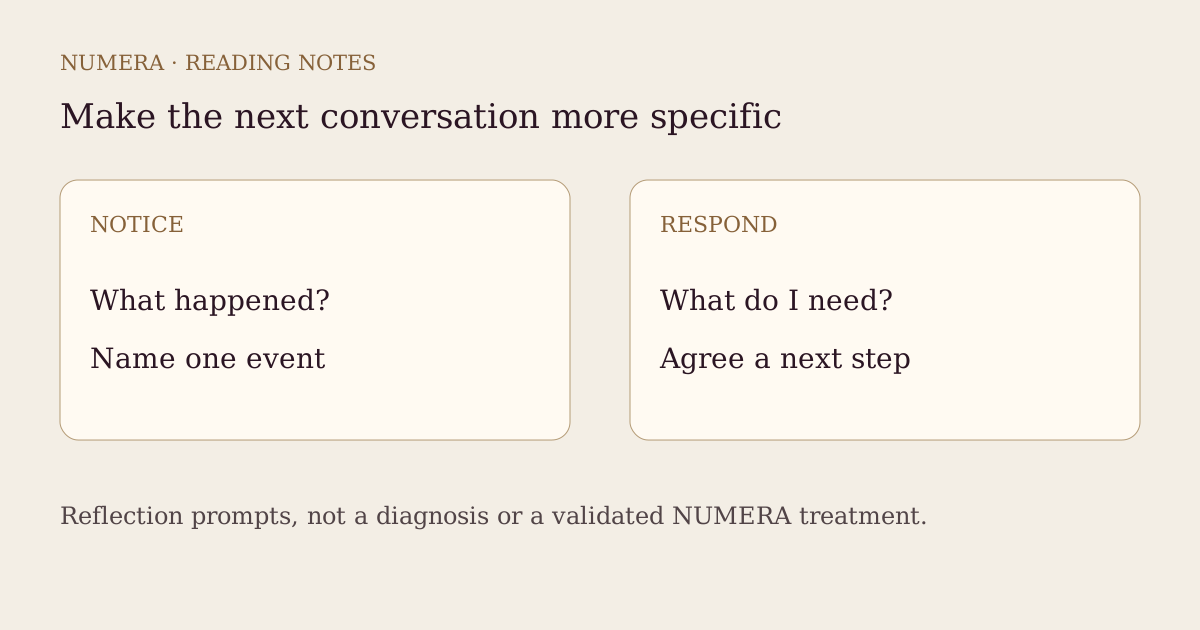
You are probably not arguing about the same thing
When 431 low-income couples were each asked, separately, to name their three biggest relationship problems, only 2% agreed on all three. About 31% agreed on two, and 81% agreed on at least one — which means roughly one couple in five could not name a single shared problem.
Different priorities are one possibility worth checking: ask each other what problem you are trying to solve. This study did not establish that disagreement about priorities causes most recurring arguments.
The pursue–withdraw loop is not a gender trait
The familiar shape — one person presses for discussion, the other goes quiet, the pressing increases — is real and well measured. A meta-analysis of 74 studies covering 14,255 people found the effects almost identical in both directions: .380 when one partner pursues, .392 when the other does.
Whatever the popular framing says, this is a loop two people build together, and either can be in either seat. That matters practically: the exit is usually available to whoever notices the loop first, not to whichever person the story says is at fault.
Sleep and context can matter during conflict
Some of the strongest findings about conflict are not about what is said at all.
- Sleep: among 71 couples discussing conflict, resolution was most likely when both partners reported being well rested. This association does not mean one tired partner makes resolution impossible.
- Evening blood glucose: across 107 couples tracked for 21 days, lower evening glucose was associated with stronger aggressive impulses toward a partner.
- Calming down works; venting does not. Across 154 studies covering 10,189 people, activities that lower arousal produced g = −0.63 on anger, while activities that raise it — running, hitting something — produced g = −0.02, which is nothing.
- Repair works best early and warm. Attempts made in the first minutes of a conflict do the most; humour and taking responsibility land, and appealing to logic does not.
Numbers about couples that do not survive checking
This field has a folklore problem, and repeating it is how a reader ends up planning around something that was never measured. Four of the most repeated claims:
- "69% of relationship conflicts are perpetual." Traceable only to a commercial book, with no sample size and no peer-reviewed source.
- "The marital 5:1 ratio was retracted in 2013." That correction concerned a different model of human flourishing, with proposed thresholds of 2.9 and 11.6. It did not retract the marital 5:1 claim.
- "Divorce can be predicted with over 90% accuracy." That figure comes from classifying couples after the outcome is known. When tested predictively, positive predictive value fell to 29%, and to about 21% at real-world divorce rates; a later replication on 85 couples reported that the major findings failed to replicate.
- "Money is the number one thing couples fight about." In a study logging 748 real conflicts from 100 couples, money ranked sixth (18–19%), behind children (36–39%), chores (24–25%), communication (22%), leisure (20%) and work (19%). Money arguments were, however, about twice as likely to be postponed — which is probably where the myth comes from.
What to do with a recurring argument
Specific if–then plans have evidence for goal attainment across 94 tests, with an average effect of d = .65. That finding spans different goals; it does not establish the best method for a couple's recurring argument.
One example to consider together: if either of us is too tired to continue, we agree on a time to return to the topic. The timing and agreement must suit both people. This is a suggested application, not the intervention tested in that meta-analysis.
A shared label may also provide a starting point. Laboratory affect-labeling findings concern responses to emotional images; they do not prove that naming a relationship pattern, or reading NUMERA, reduces conflict.
Questions people ask
Why do couples have the same argument over and over?
There can be several reasons. One study found that 431 low-income couples often ranked their main problems differently; it did not establish the cause of recurring arguments. Checking what each person wants to address is a practical starting point.
Is it true that money is the number one thing couples fight about?
No. In a diary study of 748 conflicts among 100 couples, money ranked sixth at 18–19%, behind children, chores, communication, leisure and work. Money conflicts were about twice as likely to be postponed, which may be why they feel larger.
Does venting anger help before a difficult conversation?
No. A review of 154 studies covering 10,189 people found that arousal-lowering activities reduced anger at g = −0.63, while arousal-raising activities such as running or hitting something produced g = −0.02 — effectively zero.
Does one partner being tired really change how a conflict goes?
In the cited study of 71 couples, being well rested was associated with more successful resolution. It was not evidence that tiredness always prevents resolution or a trial of a particular bedtime rule.